A modern phishing email operates as a highly calculated, psychologically driven cyber espionage tool designed to exploit core human behaviors such as institutional trust, urgency, and personal curiosity. Although historical adversaries relied on broad, untargeted spam distributions, contemporary threat actors methodically harvest intelligence from public social media profiles to engineer hyper-personalized communications. Because these fraudulent messages seamlessly mimic routine shipping updates from major logistics networks or urgent account alerts from essential cloud service providers, busy individuals routinely overlook minor structural anomalies. Ultimately, maintaining an uncompromising posture of professional skepticism whenever an unverified message demands immediate action represents a user’s premier defense against digital compromise.
The Structural Blueprint of Fake Government Emails
Among the most severe threats facing contemporary networks are highly authentic fake government emails that precisely replicate the complex visual identity of federal regulatory agencies. Because citizens naturally respect regulatory authority, digital adversaries intentionally weaponize official departmental insignias and dense legal phraseology to effectively neutralize an individual’s standard analytical framework. For instance, a fraudulent message might masquerade as a high-priority alert from a national tax authority or an international trade commission, alleging severe compliance violations requiring immediate financial settlement. Nevertheless, official regulatory bodies almost universally mandate physical postal delivery for critical statutory notifications, meaning sudden digital demands for immediate capital distribution should immediately prompt comprehensive internal security reviews.
Beyond the distressing legal prose, these institutional scams invariably require individuals to interact with external digital portals to quickly resolve the fabricated operational crisis. To preserve personal identity integrity, users must establish rigorous habits of analyzing every graphical component, identifying inconsistent layout grids, or spotting unusual cryptographic signature implementations. Let us examine the primary structural pillars that define these sophisticated institutional threats:
If you want to stay ahead of modern con artists, you can’t just react to the news—you need a personal playbook. That is exactly why we created our premier digital guide: “7 Things Every Adult Should Know When Navigating Online.” > Written specifically with seniors in mind, this guide strips away the condescending tech-speak and gives you the exact, actionable blueprints to protect your retirement, your identity, and your peace of mind.
Cybersecurity Tips for Seniors: The Complete 2026 Digital Defense Playbook
Manipulated Institutional Geometry: Fraudulent operators flawlessly mirror official government branding, yet the underlying transmission metadata consistently reveals non-governmental infrastructure origins.
Generalized Target Identification: Legitimate regulatory authorities explicitly reference unique personal account numbers, whereas sophisticated adversaries often deploy broader administrative titles to compromise multiple individuals simultaneously.
Irregular Settlement Mechanisms: Sovereign regulatory agencies never authorize or request immediate digital currency transactions, unverified offshore wire transfers, or commercial prepaid mechanisms to resolve consumer compliance liabilities.
Digital Safety for Seniors Online
While sophisticated cyber threats impact internet users across every demographic, modern digital adversaries disproportionately design their malicious campaigns to exploit older populations (Parti, n.d.). According to data monitored by global law enforcement bodies, senior citizens face escalating economic risks due to age-related gaps in formal digital literacy and a lifelong conditioning toward institutional trust (Brata et al., 2026). Furthermore, contemporary threat actors weaponize advanced artificial intelligence engines, such as commercial variations of generative software, to instantly eradicate the poor syntax that historically served as an obvious indicator of fraud (Chetty, n.d.). Consequently, safeguarding seniors online requires distilling technical defense strategies into simple, repeatable behavioral habits that can be easily executed on any home computer or mobile device.
To effectively protect your family members or yourself from advanced identity theft, you must recognize that cybercriminals deliberately create intense emotional triggers to cloud rational thought. Let us review the foundational rules that every senior should memorize to accurately determine email link safety and verify sender validity:
The Golden Silence Rule: Legitimate institutions—especially banks, utility corporations, and medical providers—will never ask you to verify your full social security number, account passwords, or personal identification numbers (PINs) via an incoming email message.
The Unsolicited Link Intercept: If you receive an unexpected electronic message from a major shipping network or a government service containing a prominent digital button, never interact with it directly. Instead, open a separate browser tab and navigate to the official organizational platform independently.
The “Slow Down” Protocol: Scammers thrive on manufacturing artificial tech emergencies, such as claiming your streaming service has been canceled or your computer is infected. If an incoming message demands that you act immediately, it is almost certainly a fraudulent psychological operation.
Technical Domain Mechanics: Reading from Right to Left
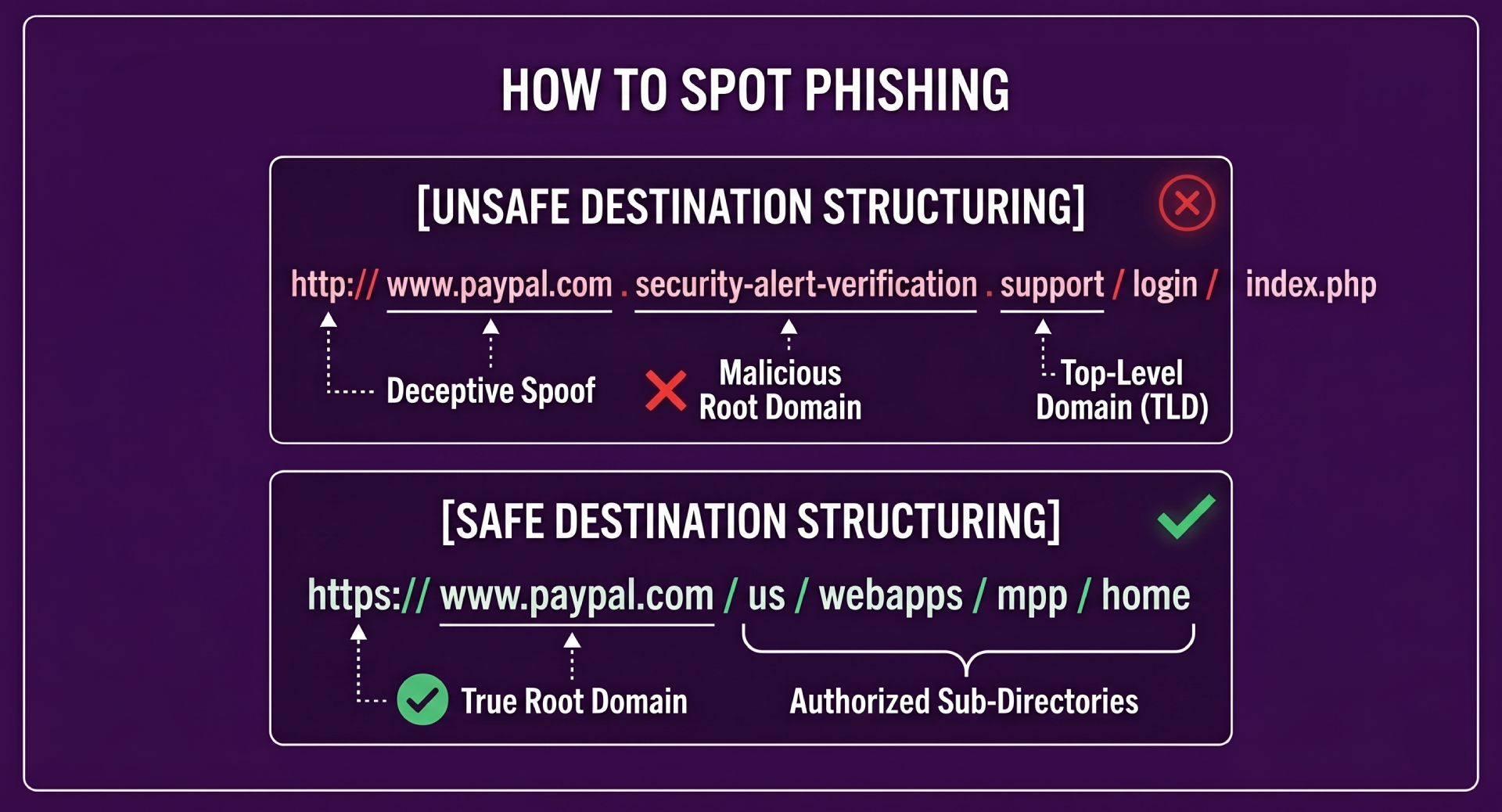
To effectively neutralize sophisticated social engineering tactics, individuals must learn to read web addresses from right to left rather than following standard Western reading patterns. Specifically, the true owner of a digital destination is determined strictly by the root domain and the top-level domain (TLD) found immediately preceding the first single forward slash. For instance, an address such as [www.netflix.com](https://www.netflix.com).account-update.xyz/login does not belong to Netflix; it belongs to the unauthorized root domain account-update.xyz. By focusing your analytical gaze exclusively on this critical structural junction, you strip away the deceptive nomenclature that attackers deploy to mimic legitimate enterprise networks.
To help you visually parse these complex digital destinations during your daily validation procedures, look at how malicious actors assemble structural components compared to safe, legitimate infrastructure paths:
How to Spot A Sophisticated Phishing Email
Deploying an Advanced Digital Defense Framework
While spotting visual discrepancies represents a powerful personal capability, building true digital resilience requires embedding automated technical protocols into your daily technological lifestyle. First and foremost, activating robust multi-factor authentication (MFA) across every single digital profile ensures that even if an adversary successfully harvests your credentials, they cannot breach your accounts without your secondary verification token. Furthermore, integrating dedicated password management utilities completely eliminates the risk of human error, as these automated applications natively refuse to autofill saved credentials into look-alike domains that do not precisely match the original registration records. Ultimately, blending consistent psychological skepticism with automated verification tools establishes an incredibly formidable barrier that keeps your personal data secure.
The Golden Rule of Digital Correspondence: When an unexpected communication demands immediate action or threatens negative consequences, navigate directly to the official organization website through a fresh browser tab—never use the contact pathways embedded within the suspicious notification itself.
Closing the Loop on Personal Cybersecurity
In summary, the democratization of cybercrime means that sophisticated social engineering threats are a persistent reality for anyone utilizing modern communication platforms. However, by transforming your approach to your inbox from passive consumption to active technical scrutiny, you can easily neutralize the efficacy of even the most polished campaigns. Remember, checking sender address validity, analyzing domain hierarchies from right to left, and verifying link architectures form your primary shield against modern digital adversaries. Stay vigilant, rely on established security tools, and never let artificial urgency compromise your critical thinking skills.
Take Action Today: Join the RHYNO SHIELD Program
Empowering the seniors in your life with robust digital defense strategies requires interactive, structured instruction rather than basic technical reading lists. To confidently secure your household or shield your older family members from advanced social engineering threats, consider enrolling them in our dedicated RHYNO SHIELD program. Specifically engineered to equip seniors with actionable, real-world defensive methodologies, this comprehensive curriculum utilizes immersive simulations to transform digital vulnerabilities into an unshakeable fortress of personal cyber awareness.