

The “PHP2Shell” Flaw Explained: Why Websites Running PHP Must Update Today
For those of us in DevOps and infrastructure management, the phrase “unauthenticated remote code execution” is enough to ruin an entire week. But when it applies to PHP—the underlying engine still powering a massive chunk of the web—it becomes an all-hands-on-deck emergency. Today, October 21, 2026, the official patches for the much-dreaded “PHP2Shell” vulnerabilities finally dropped. Leaked early on a forum and validated by security researchers, the sudden, uncoordinated disclosure threw IT operations teams worldwide into a frenzy. We weren’t just racing against threat actors; we were racing against a blind embargo, waiting anxiously for 14:00 UTC to finally get our hands on the fixes for CVE-2026-109618 and CVE-2026-109619.
From a systems administration perspective, these two flaws—both rated a critical CVSS 9.2—are pure nightmare fuel. The first vulnerability, CVE-2026-109618, exploits an Out-of-Memory (OOM) corruption, while CVE-2026-109619 leverages a stale global state mechanism. What makes them genuinely terrifying is the attack vector: virtually any PHP installation serving web requests is fair game. If your stack relies on Apache with mod_php, the risk is catastrophic. An unauthenticated request can trigger the exploit before a single line of your application code even executes. Security firms estimate over 884,000 internet-facing hosts are currently exposing vulnerable, outdated PHP banners. For those of us managing fleets of servers, this isn’t just a code vulnerability; it’s a widespread architectural crisis.
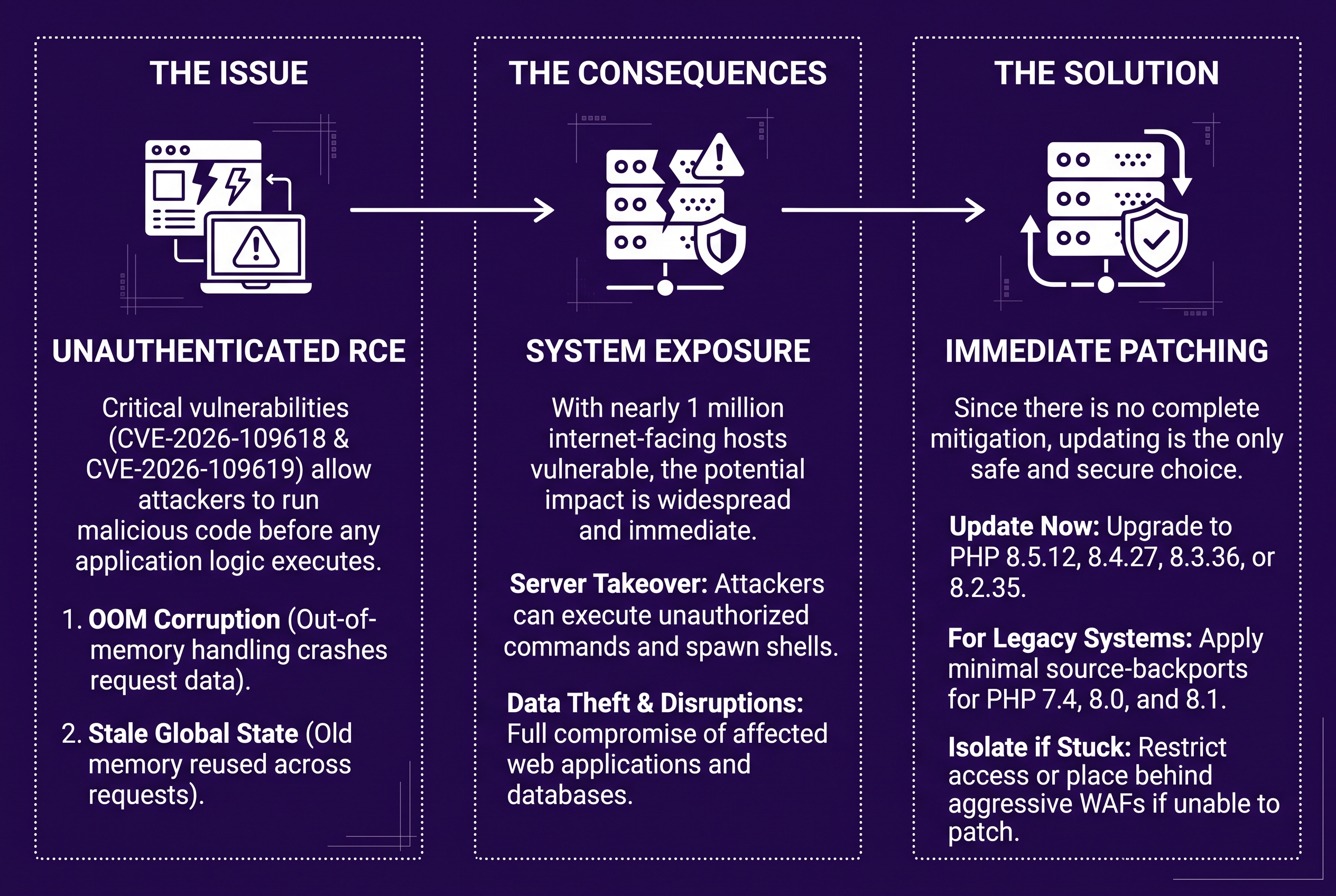
Before the official 8.x point releases landed today, the security community was scrambling to apply digital duct tape. The official PHP mitigation advice—while technically sound—felt like fighting a forest fire with a garden hose. We spent the morning tweaking FPM pools to set memory_limit=-1 (a terrifying prospect for server stability) and dialing down post_max_size to block the OOM corruption paths. For the stale global state flaw, we had to brutally disable session.upload_progress.enabled and restart thousands of worker processes. But as the PHP core team explicitly warned: these measures do not make an installation safe. They only obscure the known exploitation paths. True security requires a binary upgrade to PHP 8.5.12, 8.4.27, 8.3.36, or 8.2.35.
PHP2Shell is also forcing a brutal reckoning with technical debt. The harsh reality of enterprise IT is that legacy code exists. While upgrading the active support branches (8.4 and 8.5) is a standard CI/CD pipeline task, the real panic is happening on legacy servers. PHP 8.1 and older are officially End of Life (EOL). If you are running PHP 7.4, 8.0, or 8.1, the PHP project does not provide official binary updates. Yes, the security team threw the community a rare lifeline by providing “minimal source-backports” for these dead branches due to the sheer severity of the flaw. However, compiling from source across a fleet of legacy enterprise servers is simply not a viable mid-week project. It requires relying on LTS vendors or isolating those applications entirely behind aggressive Web Application Firewalls (WAFs) and VPNs.
As of this writing, we haven’t seen widespread in-the-wild exploitation for PHP2Shell. But we all remember the fallout from similar CVEs in the past—exploit attempts usually hit honeypots within 24 hours of a patch release. The clock is ticking. This emergency is a stark reminder that infrastructure resilience requires the agility to patch core runtime environments in hours, not weeks. For now, update your active branches, isolate your legacy boxes, and monitor your php-fpm and apache2 logs for rogue processes spawning shells. The patching window is closing fast.
UPDATE NOW! https://www.php.net/archive/2026.php?utm_campaign=Critical+PHP+Vulnerabilities+Comms&utm_content=Email+1&utm_medium=email_action&utm_source=customer.io#2026-10-20-1